

A serene autumn waterfall cascades through a colorful forest with vibrant red and orange leaves

Item Recovery & Repair

Item Recovery & Property Restoration

We understand that personal belongings carry irreplaceable emotional value. This hub is dedicated to helping you reunite with lost property and providing expert guidance on safely salvaging and restoring flood-damaged items in Kerr County.

A woman with a tattooed arm holds up a blue and white striped dress with lemon prints

The Found Project

The Found Project is a community effort dedicated to collecting and cataloging belongings recovered during clean-up and debris removal operations.

Salvaging Damaged Items

Safety is paramount when handling damaged items. Once property has been declared safe to enter, local businesses and households can take advantage of our item restoration resources to salvage damaged items. Heart of the Hills Heritage Center partnered with TX-CERA to create crucial video resources on safely salvaging damaged items, including photos, documents, and furniture. Guidance is available for: moisture mitigation, salvaging electronics, drying furniture, and preserving important documents.

Video Resources

Additional Resources

This glossary defines terms that are useful in describing the condition of collections. It is valuable to describe condition because that information can be used to track change over time and prioritize future collection care goals.

All collections of works of art on paper are vulnerable to damage or destruction as a result of natural disasters like hurricanes, tornadoes, floods, or the ravages of fire, burst pipes, or furnace malfunction. Although disaster preparation and prevention can limit the damage that occurs, serious injury to a few or many artworks can nevertheless result from extreme weather, smoke, fire, or mechanical failure. This technical bulletin provided by the Conservation Center for Art & Historic Affairs describes how to plan an efficient recovery from disasters affecting works of art on paper. The discussion includes preparing for a disaster; assessing damage and setting salvage priorities; advantages and disadvantages of various recovery options; and additional resources for information and advice. The emphasis is on procedures for dealing with water damage, with a brief section on fire-related damage. In all emergencies affecting art on paper, it is essential that a paper conservator who is experienced in disaster recovery be included in the salvage process.

Every cultural institution, most offices, and many private homes house collections of books. Many of these collections will experience a water catastrophe, large or small, at some time. Small emergencies — a leaking pipe or roof, or a flooded basement — are the most prevalent and easily contained. Whether the emergency is large or small, however, a quick response is essential to fully salvage wet volumes. This technical bulletin provided by the Conservation Center for Art & Historic Affairs reviews the range of effective options for drying wet books. For a successful recovery, it may be important to seek the advice of a book conservator or a specialist in library preservation, especially when rare books or large collections are damaged.

Photograph collections are susceptible to damage from catastrophic disasters of all types, including floods, fires, hurricanes, and tornadoes. In most such disasters, as well as in smaller emergencies, water damage is widespread — whether from leaking or burst pipes, flooding, or firefighters’ hoses — and photographs may be permanently disfigured. This technical bulletin provided by the Conservation Center for Art & Historic Affairs focuses on procedures for responding to water emergencies. In all such emergencies, it is essential to first seek the advice of a photograph conservator with experience in salvaging water-damaged materials.

Review steps provided by the Federal Emergency Management Agency (FEMA) to save your family treasures, quick tips, fact sheets, and additional resources.

Film and tape is very susceptible to damage from water, especially flood water that will be contaminated with dirt and debris. Each type of object is affected in a slightly different way and requires a slightly different approach in preventing further damage. In all cases, the sooner you can start recovering the objects, the greater the chance of minimizing damage. However, the aftermath of a flood is dangerous with many unexpected hazards, so do not endanger your personal safety in an attempt to salvage your collection. Also be aware that wet objects may be contaminated with a range of biological or chemical hazards and good hygiene is required when handling flood affected objects.

The National Film & Sound Archive of Australia can assist by providing information on the best ways to stabilize your flood damaged objects and give these precious objects the best chance of recovery.

Review information about salvaging books, inorganic objects, magnetic and optical media, paintings, photographic materials, and skin & leather.

Review step-by-step directions for responding to water emergencies affecting inkjet prints that will guide responders from the moment of access to the wetted collection to fully-dried prints.

Review recovery priorities and preservation techniques for various water-damaged materials, including paper documents, books, works of art on paper, photographs (black and white/color), and computer media. The chart outlines the required handling precautions, specialized packing methods, and the preferred drying method (air, vacuum, or freeze drying) for each specific material type.

Kathleen Kiefer reviews five points to consider when restoring wet textiles.

Debris & Waste Removal

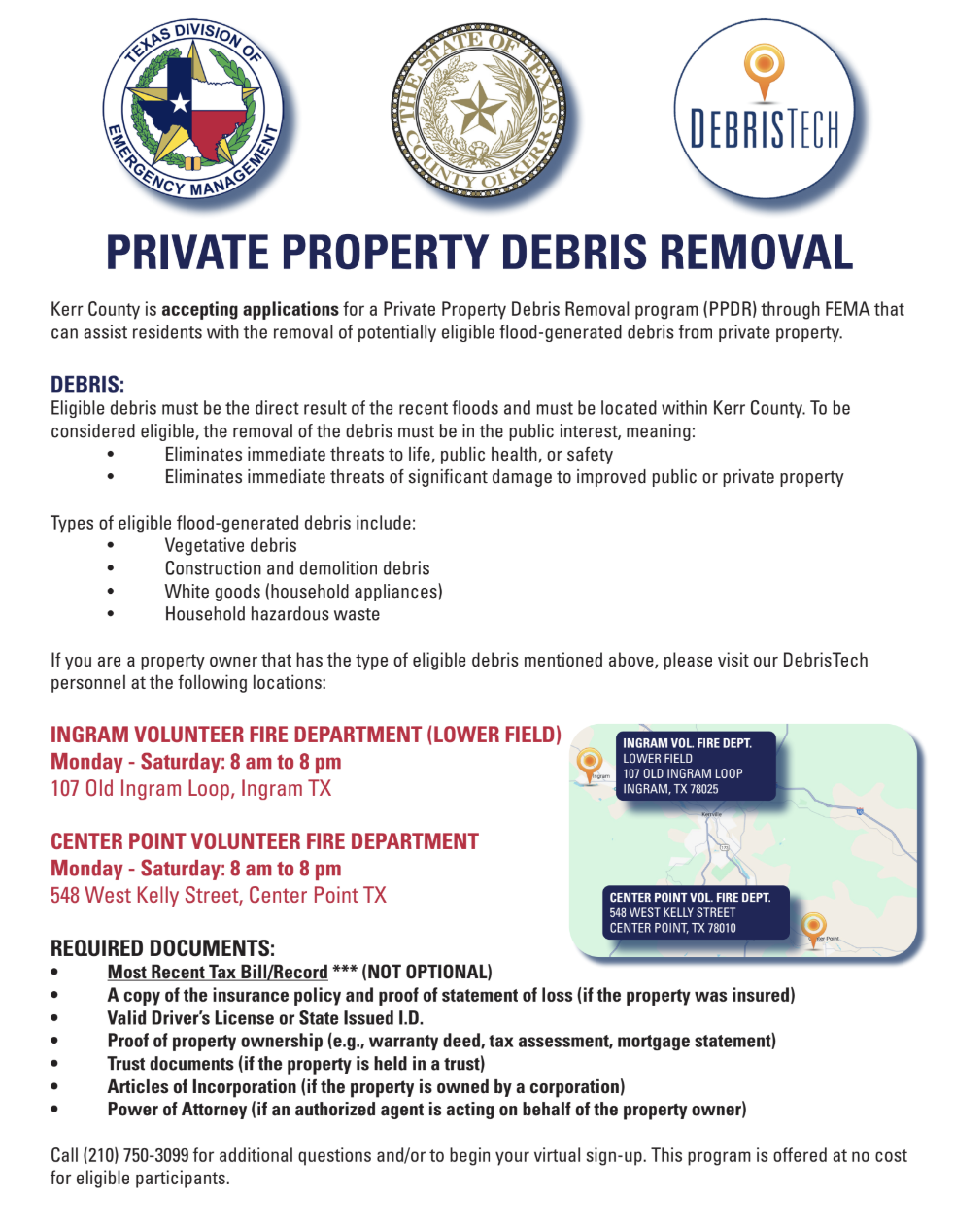
Programs and sites change over time. Follow the latest Kerr County updates for curbside debris collection, transfer station options, and any special drop‑off events. If curbside programs have closed:

  • Self‑haul to approved facilities. Separate debris by type (construction, appliances, vegetation, hazards).
  • Keep photos and receipts for potential reimbursement.
  • Do not place personal keepsakes intended for recovery in debris piles.
Report Lost & Found Items

To file a report, schedule a pickup of a lost item, schedule drop-off of found items, or to check the catalogue of recovered belongings, please complete the following form.

About You

Name(Required)
Preferred Contact Method(Required)
Select all that apply.
Address(Required)

What Happened

I am reporting a…(Required)
Date of Discovery(Required)
Time of Discovery(Required)
:
Address(Required)
Share the address where the item was last seen or where it was recovered.
Item Category(Required)
Type, brand, color, size, distinctive marks, etc.

Photos & Proof

Required for found items.
Drop files here or
Max. file size: 2 GB, Max. files: 5.
    Receipts, prior photos, serial numbers, affidavit, etc.
    Drop files here or
    Max. file size: 2 GB, Max. files: 10.

      Logistics

      Preferred Pickup / Delivery Option(Required)
      Please indicate when you are available to drop off or pick up items.
      Gate codes, mobility needs, etc.

      Consent & Notices

      Continuing the Recovery